
The Precision Paradigm: Dr. Mansoor Ali Yusuf Baig’s Systemic Modernization of Healthcare Research and National Medical Registries
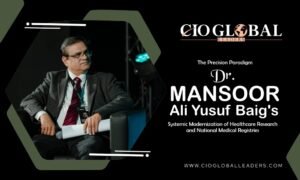
Today’s innovation catalysts, especially in the healthcare research and medical technology sector, are those who are upgrading clinical systems for scientific discovery. Meet Dr. Mansoor Ali Yusuf Baig. He is moving healthcare research out of slow, isolated storage systems. And is redefining it by pushing it into an active era of digital transformation.
He commands twenty-eight years of deep experience as the leader of the research and innovation digital strategy and currently affiliated with King Faisal Specialist Hospital & Research Centre (KFSHRC). His expertise is in software development, information technology, and advanced data environments. In that capacity, he actively redesigns how medical researchers interact with patient insights.
It helps them in building a practical framework where machine learning and digital health solutions fast-track scientific breakthroughs. His daily work replaces traditional administrative processes with automated platforms, ensuring that global clinical investigators can analyze complex multi-modal data profiles and patient records with immediate clarity.
His methodical management strategy addresses the core logistical roadblocks that historically delay clinical innovations across Saudi Arabia. Armed with a doctorate from Glocal University and advanced degrees from Alagappa University, Symbiosis, and the University of Pune, Dr. Mansoor applies clear engineering logic to complex biological data challenges. He translates massive data libraries into accessible, real-time research utilities, allowing physicians to spot disease trends instantly and customize experimental treatments for complex patient needs. He focuses heavily on system integration rather than short-term tech trends. And creates a scalable infrastructure. In such a way, throughout the Middle East, he shapes the future of modern medicine.
The Human-First Paradigm: Translating Scientific Computing into Tangible Patient Value at KFSHRC
As healthcare technology strategist, Dr. Mansoor has often stated that technology should serve humanity rather than just follow trends. And during his previous experience as the Head of Scientific Computing, he always ensured that every algorithm or data strategy at KFSHRC ultimately translates into a measurable value for a patient in a hospital bed. The healthcare domain stands as the premier landscape for AI innovation, where the inherent complexities of medicine are effectively harmonized through the precision of scientific computing. This discipline serves as the indispensable bridge between healthcare IT and clinical practice, requiring a sophisticated fusion of skillsets from both sectors to drive meaningful research. By positioning scientific computing as the primary orchestrator, we transform uncertainty into a structured framework that supports the next generation of medical breakthroughs. As a technology strategist and former Head of Scientific Computing at the KFSHRC, he prioritizes a clinical-first methodology that ensures every algorithm and data strategy translates into measurable patient value. His digital transformation strategy begins with a robust data foundation, emphasizing meticulous organization and strong governance to create a well-orchestrated AI platform. “By focusing on the basics of digitization and digitalization, we establish a reliable infrastructure where technical design is always preceded by clearly defined clinical goals and success metrics,” he says. To ensure long-term impact, every analytics workflow is mapped to specific clinical outcomes such as earlier diagnosis, safer treatment selection, and improved triage. “We quantify success using rigorous endpoints like accuracy, treatment effectiveness, and clinician time saved, ensuring that technology serves the mission of care. Furthermore, we maintain a cycle of real-world evaluation where models are continuously validated for reliability, monitored for performance drift, and refined through direct clinician feedback to guarantee they remain safe and effective in practice.” he adds.
The Multi-Modal Repository: Harmonizing Specialized Research Infrastructure for Smart Hospitals
Dr. Mansoor informs that KFSHRC has recently been recognized among the ‘World’s Best Smart Hospitals.’ The Scientific Computing at the Research and Innovation bridges the gap between General IT development/infrastructure and the specialized demands of cutting-edge healthcare research. Research & Innovation Digital Transformation is its key function, ensuring smooth functioning of the Research & Innovation facility as far as research infrastructure, systems, and data elements are concerned. It also acts as the primary facilitator of an integrated multi-modal data repository of data sources. This rich repository includes sources covering the EHR, Imaging, Research, multi-omics, biobank, and more data sources available in a tertiary care/quaternary care facility. That means standardizing and harmonizing heterogeneous data, ensuring data quality, and transforming raw (multi-modal) healthcare data into model-ready representations that AI/analytics can use reliably.
In an era where ‘AI’ is a buzzword, Dr. Mansoor’s framework prioritizes ROI certainty and operational readiness. As an Enterprise Digital Transformation and AI Strategist, his framework cuts through the current AI hype by strictly distinguishing between isolated ‘innovation experiments’ and the robust, long-term ‘platform transformations’ required by a national healthcare institution. While pilots prove technical capability in sandbox environments, true platform transformation absorbs systemic complexity, assuming data is messy, real-time, and multi-modal. At KFSHRC, Dr. Mansoor shares that they shift the definition of ROI away from abstract data science metrics and focus instead on clinical throughput efficiency, resource optimization, and cognitive load reduction. This ensures that every AI deployment transitions seamlessly into ‘business as usual’ workflows, directly advancing the institution’s mission under Saudi Vision 2030.
Platform Transformation: Engineering Custom Orchestration and Sovereign Foundations under Saudi Vision 2030
To guarantee long-term platform resilience, his strategy de-risks implementation by prioritizing a secure, sovereign multi-cloud foundation capable of handling intense high-performance computing (HPC) loads while maintaining strict data governance. Rather than relying on rigid, outsourced monolithic black boxes, he champions custom orchestration and Specialized Language Models (SLMs) tailored to our precise clinical and research datasets, allowing KFSHRC to retain absolute data control and agility. Ultimately, by embedding transparency, interpretability, and ethical governance into the core architecture, we transform complex healthcare data into predictable, operationalized assets that deliver sustained clinical value and elevate patient care on a national scale.
The Evolution of Clinical Registries: Building Quality Data Repositories for High-Performance AI Orchestration
Dr. Mansoor’s early work building clinical and disease registries established the essential data layers that now fuel today’s advanced systems. Moreover, as he always mentioned that registries are the best repositories for AI, as they are truly a quality data source which are AI Ready. Historically, registries served as static, retrospective databases meant for tracking historical patient trends and compliance. Over his 28-year career, this foundational data architecture has evolved into a dynamic ecosystem where high-performance computing (HPC) and real-time data ingestion seamlessly blend complex clinical data with human workflows. He reveals, “We have transitioned from simply archiving historical records to orchestrating intelligent systems that analyze live, multi-modal research and clinical data streams, driving proactive decision-making across the institution.” Today, managing these ecosystems as an AI Strategist requires bridging the gap between cutting-edge technology and clinical realities. Instead of deploying rigid, outsourced solutions, he champions custom orchestration and Specialized Language Models (SLMs) built directly upon a secure, sovereign multi-cloud foundation. This approach ensures that their modern registries are not just passive data repositories, but highly secure, interpretable, and ethically governed intelligence platforms. By aligning these sophisticated data assets with operational workflows, he actively transforms raw clinical research into predictive, human-centered insights that directly advance Saudi Vision 2030’s healthcare transformation goals.
The Human-in-the-Loop Imperative: Architectural Safeguards, Ethical Decision Support, and Data Contracts
Mansoor advocates for ‘explainability’ and ‘human-in-the-loop’ mechanisms in high-risk clinical workflows, while addressing the “human friction” that often occurs when clinicians are asked to trust a machine’s predictive insight over their own intuition. He says he must stress something. “Firstly, let me be very clear that ethically AI should never be decision making system in a healthcare setting, although it can be a wonderful tool for decision support.” Human intervention, at least as a decision maker, is mandatory both practically and ethically, and he is sure in his perspective on this that it will hold true at least for the next ten years. With the increasing use of synthetic data and iterative validation, there are some core data contracts he enforces to ensure patient privacy and eliminate bias before a model ever reaches the clinical floor. To protect patient privacy and eliminate bias before an AI model ever touches the clinical floor, his strategy would always enforce strict, multi-layered data contracts that govern both synthetic and real-world data pipelines. As a digital transformation and AI strategist, he treats data contracts not just as legal agreements, but as automated architectural safeguards embedded directly into our sovereign multi-cloud infrastructure. These contracts would enforce rigorous, mathematically verifiable privacy standards—such as differential privacy and absolute de-identification—ensuring that synthetic data generation cannot leak sensitive patient attributes or be reverse-engineered. “By establishing these hard boundaries at the infrastructure layer, we secure high-performance clinical research data while maintaining complete regulatory compliance under Saudi Vision 2030,” he shares.
Reciprocal Learning and Quiet Leadership: Bridging Technical Capability with Clinical Reality
Digital transformation is as much about people as it is about code. I believe in fostering a culture of ‘continuous learning’ among my multidisciplinary teams of engineers and scientists to keep pace with the 2026 tech landscape. Considering Digital Transformation & AI in the healthcare domain and scientific computing, the goal is to bridge the gap between technical capability and clinical reality, ensuring that team members, i.e., engineers, data scientists, and clinical researchers, continuously cross-train in each other’s disciplines to keep pace with rapid technological shifts. To unify a fragmented skillset, a highly effective strategy is the implementation of a reciprocal learning framework. Engineers and scientists participate in ‘clinical shadowing’ and data-immersion sessions, while clinicians engage in foundational AI literacy workshops. Secondly, allocating dedicated segments of the work week for exploratory research, rapid prototyping, and journal reviews allows engineers and scientists to experiment with emerging open-source tools without the pressure of immediate project deadlines. Lastly Continuous learning must be explicitly tied to measurable institutional outcomes to prevent training fatigue.
Referring to the idea that true presence needs no announcement, Dr. Mansoor exercises ‘quiet leadership’ within the complex hierarchy of a major research hospital to drive consensus on radical technological shifts. Instead of making loud announcements about radical technological shifts, true influence is built quietly by mapping technical innovations directly to the existing strategic priorities of clinical and administrative leaders. By listening first, understanding the specific pain points of different departments, and reframing a new data or AI strategy as the natural solution to their pre-existing goals. When an algorithm demonstrably saves a clinician time or directly improves a patient outcome, the data speaks for itself. This results-driven approach shifts the organizational culture organically, turning a radical technological leap into an inevitable, widely supported evolution that needs no formal introduction.
An Advanced Vision for Everlasting Legacy: Building an AI-Ready Future Framework for Tomorrow’s Systems
Dr. Mansoor furthers that KFSHRC’s advanced computational work is directly accelerating Saudi Arabia’s Vision 2030 objective to become a global leader in biotechnology and precision medicine. Its computational strategies are intentionally moving the needle from localized research to scalable, national-level health security and precision care. A prime example of this is its automated bioinformatics pipelines and our internationally accredited metagenomics research services, which allow for rapid, AI-driven identification of mutated or resistant pathogens far faster than traditional microbiology.
Finally, looking back at his nearly three-decade journey from India to the UAE and then to Saudi Arabia, Dr. Mansoor feels that the true definition of a lasting legacy shifts from the temporary novelty of the code they as a team write to the enduring permanence of the systems they build. He hopes that the legacy of his work rests on having engineered an invisible, unbreakable bridge between complex computational architecture and the sacred mission of clinical care. “I want the specialized data platforms, scientific computing infrastructures, and AI frameworks established today to serve as a timeless foundation,” he adds.
Although he has a long list of unique research systems under his digital transformation strategy, Mansoor had previously built and plans to improve on the comprehensive AI-ready research data management platform, which is seamlessly integrated with all the endpoints, an institutional Clinical trial management system, which is further closely integrated with the data management solution.
Read Also: The Strategic Mind Behind Sustainable Transformation