
Spatial computing, XR and Mixed Reality: How immersive tech might reshape interfaces and collaboration
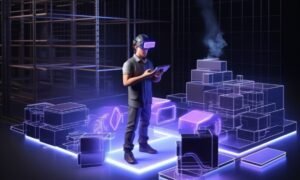
What is spatial computing and XR
Spatial Computing refers to a computing paradigm where digital content and the physical world merge, enabling interaction in three-dimensional space rather than via flat screens.
Spatial computing is a group of technologies under the umbrella of Extended Reality (XR) that comprises the primary technologies such as Augmented Reality (AR), Virtual Reality (VR), and Mixed Reality (MR). AR adds digital elements to the environment, thus giving the user a possibility to see and interact with both.
VR offers the user a complete virtual world, thus the user is physically separated from his/her surroundings.
MR combines real and virtual worlds in such a way that digital and physical objects are coexisting and can even interact with each other in real time.
The main difference between spatial computing and the traditional one is environmental awareness: the devices are fitted with sensors, depth cameras, computer vision, and AI, which help the devices to locate a user’s surroundings, realize 3D geometry, track movement, and place or interact with digital objects as if they are already a part of the physical space.
The history of immersive computing goes way back before the current XR hype. In 1992, an early augmented reality system called Virtual Fixtures, created by Louis Rosenberg at the U.S. Air Force Armstrong Labs, operated by exoskeletons and stereoscopic visuals, which allowed users to control robotic arms that seemed to be at the exact location of their real arms. This was one of the first spatially-registered immersive systems.
During a couple of decades the progress in sensor technology, computer vision, 3D graphics, AI, and real-time processing has opened a fertile ground for more enriched immersive experiences. As time went by, spatial computing became mature thus leading to the emergence of XR technology as a practical concept rather than a science fiction idea.
At present, spatial computing is being increasingly recognized as a subsequent step after desktops and mobile: a computing mode where digital experiences do not live on a screen but rather stay in physical space.
How spatial computing works — the tech behind immersion
Spatial computing depends on a mix of hardware and software:
- Sensors like depth cameras, LiDAR, inertial measurement units (IMUs), and environmental scanners locate the physical area.
- Computer vision and machine-learning algorithms analyze the data collected by the sensors to identify surfaces, objects, edges, and the layout of the space.
- Spatial mapping is actually building a 3D representation of the environment in real time. It allows digital content to be delivered with the right scale, direction, and location, attending to the user’s movement or the change in the physical space.
- Interaction methods are no longer limited to mouse and keyboard, thus gestures, eye tracking, voice commands, and even gesture-based hand tracking or spatial controllers can be used as normal means of communication in XR.
- Cloud and edge computing take care of the heavy workload that is necessary for high-quality graphics, real-time rendering, spatial awareness, and AI-powered context awareness to be possible even on small and light devices.
- The final outcome is a very engaging and context-aware interface, which does not demand the user to change himself/herself in order to fit the computer, but rather allows the computer to change according to the real world.
Why spatial computing matters for interfaces and collaboration
Spatial computing and XR could radically transform not only the way we content consumption and gaming, but how we collaborate, create, learn, and work. Here are the main ways the immersive tech can lead to the future of work:
Immersive collaboration and remote teamwork
- Conventional remote collaboration usually depends on video calls and 2D screens, which limit the context, spatial understanding, and the feeling of being together. By means of XR, participants in different locations can interact in a shared virtual space and work together on 3D models, objects, or environments.
- As an illustration, scientists have come up with XR collaboration web-based systems which enable a user in VR to control a virtual version of a physical object, while another user in AR views the real-world object with augmented assistance. Thus, remote teams can mutually guide each other, work together on physical tasks, and keep track of the progress happening at the same time.
- Immersive collaboration like this has a potential to radically change such areas as design, manufacturing, remote maintenance, architecture, and even education by lessening the impediments, saving the time usually spent on traveling and enabling the shared spatial context irrespective of location.
Enhanced design, prototyping, and data visualization
- Through the use of spatial computing in such fields as design, engineering, and architecture, the involved teams are given the opportunity to mock up, visualize, and make changes in 3D space even before the physical version is constructed. Rather than using traditional CAD drawings or 3D models displayed on a screen, designers can immerse themselves in a mixed-reality representation, examine spatial relationships, and discover the problems at an early stage.
- Complex data of any nature, be it architectural schematics, engineering designs, or analytics dashboards, can be more easily understood when presented in large immersive environments instead of small 2D windows. An excellent academic example of this is Dataspace, a hybrid reality environment that brought together multiple high-resolution displays, AR/VR headsets, and reconfigurable physical surfaces to help teams analyze complex datasets collaboratively.
- Immersive data interaction of this kind could be very useful in fields such as scientific research and business analytics, where there is a demand for spatial reasoning and collaboration.
Training, education, and skill development
- With the help of spatial computing, training can be made more realistic through simulation and the creation of entertaining and engaging environments for developing skills. To illustrate, in the medical field, AR or MR can visually project medical imaging, anatomy, or procedural guidance right onto the actual environment giving the surgeons an easy way to plan operations and the trainees to get hands-on experience.
- In industrial manufacturing or repair work, AR guidance may provide the step-by-step instructions visually overlaying the real machinery, thus the technicians will be able to carry out intricate tasks without the need for manual intervention.
- Education and learning platforms are not left out as well: students have an opportunity to examine 3D models, undergo simulations, and even interact with lifelike digital content thus abstract or difficult subjects turn into something tangible and understandable.
That essentially equals safer, cheaper, more flexible training, and faster learning.
Challenges and what needs to be solved
- Potential-induced high expectations notwithstanding, there are a number of issues spatial computing must tackle before can be widely accepted by the general public, viz:
- Better hardware and sensor performance are prerequisites to provide accurate spatial mapping and interaction with low latency. The first generation of devices was in many respects accountable for tracking errors, delays, and narrow field-of-view problems.
- UI technologies have to better themselves in order to be able to depend on gestures, eye or hand tracking, and vocal input, but such needs should be met consistently, naturally, and the user should not get tired of it. Besides, there is an expiration date for a novelty.
- Content along with the ecosystem is of great importance: the availability of high-quality 3D content, the presence of interoperable standards, and cross-platform systems will be the essentials. Without that, spatial computing is facing a risk of being broken up into fragments or being limited to certain areas of use.
- Privacy and morality become issues when gadgets are mapping the physical world, tracking movements, or mixing virtual with real lives. As these systems become more popular in everyday life, their being designed in a responsible way is of the utmost importance.
What the emerging future might look like — a new interface paradigm
What we are witnessing may be the beginning of a shift as significant as the move from desktop to mobile computing. Spatial computing, XR and MR could become primary interfaces in the post-smartphone era.
Imagine workspaces where remote teams gather around a life-size 3D model of a product; architects walk clients through virtual buildings placed in real spaces; surgeons rehearse complex procedures using patient-specific 3D anatomy hovering over a dining table; students dissect the solar system in their living room; analysts explore data as immersive landscapes.
In such a future, boundaries between physical and digital blur. Digital content becomes spatial, interactive, intuitive. Collaboration becomes more human, less screen-bound. The way we design, learn, work, create changes fundamentally.
Conclusion
Spatial computing and XR represent more than a new gadget or trend. They are part of a paradigm shift: a transformation of how humans interact with digital information, how teams collaborate across distance, how training and design are done.
The blending of physical and virtual worlds unlocks new possibilities for collaboration, learning, creation and communication. As sensor technology, AI, and immersive hardware continue to evolve, spatial computing may well become the dominant interface of the future, one that feels more natural, spatial, and human than screens ever could.
For anyone curious about the future of technology, collaboration or design, watching spatial computing closely is no longer optional. It is inevitable.